Gear & Essentials
Collars, Leashes, and Long Lines Explained
Collars, leashes, and long lines explained: which collar type suits your dog, how to choose leash length, and when a long line beats a retractable.
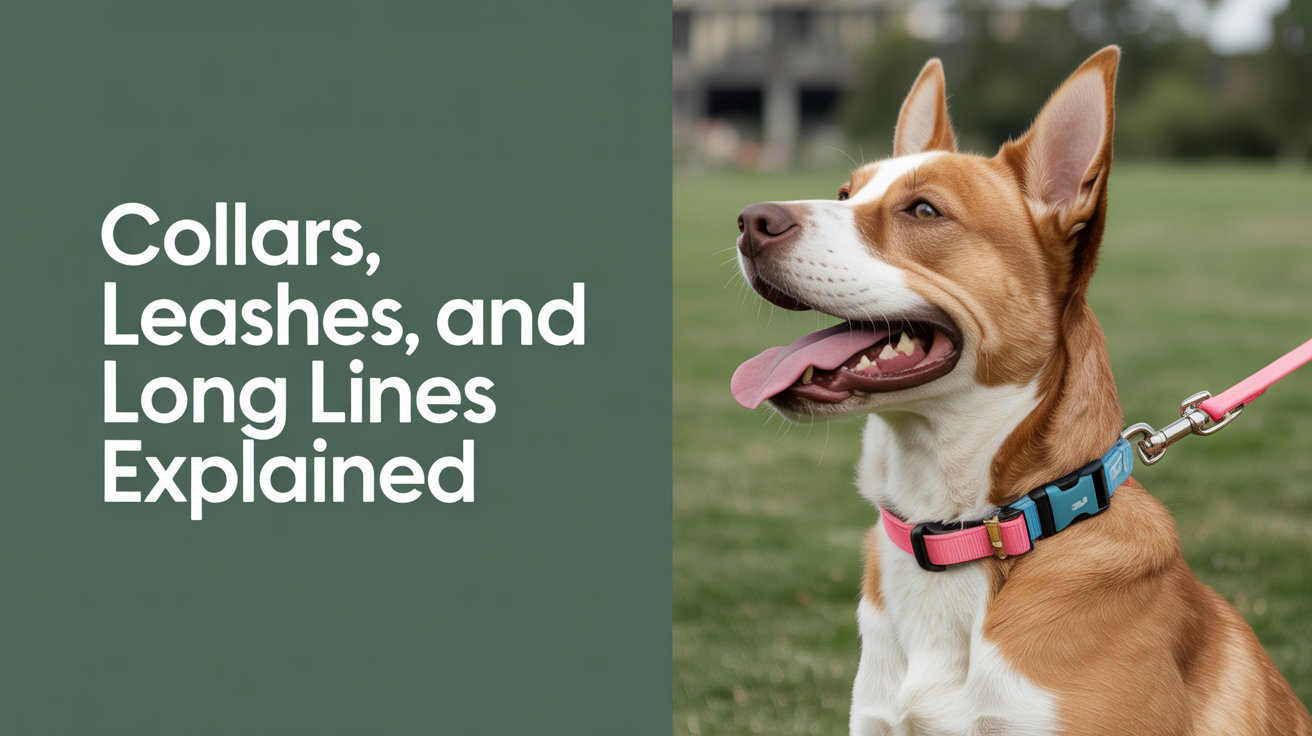
Dog leash types vary more than most owners expect, and the difference between a well-matched setup and a frustrating one often comes down to a few simple decisions. The collar your dog wears every day, the leash you clip on for walks, and the long line you might pull out for recall training each serve a different purpose. Getting them right makes training easier and reduces wear on both your shoulder and your dog's neck.
Collar types: what works and what to skip
Flat collars
The flat collar is the standard, a buckle or snap-closure collar that stays on all day, holds ID tags, and attaches to a leash. For most dogs, it's all they need. Sizing matters: you should fit two fingers comfortably between the collar and the dog's neck, with no more than an inch of slack. Check the fit every few months, especially on puppies, since necks grow faster than owners notice.
Flat collars work poorly for dogs with wide heads and narrow necks (think Greyhounds, Whippets, and similar sighthound builds) because they slip off too easily. For those dogs, a martingale is a better default.
Martingale collars
A martingale has a small loop of fabric or chain that tightens just enough to prevent escape when a dog backs up or panics, then releases again once the leash goes slack. It's a gentler solution than a prong or choke collar for dogs that slip traditional collars.
Flat collar vs martingale: if your dog has a neck wider than or equal to its head, a flat collar is fine. If the head is narrower than the neck, or if your dog has backed out of a collar before, a martingale is worth the switch.
Head collars
Head collars (brands like Halti or Gentle Leader) loop around the muzzle and the back of the skull, steering the dog's nose rather than relying on neck pressure. They can reduce pulling quickly and are useful for large, strong dogs when an owner doesn't have the physical strength to hold a flat-collar puller. They do take a deliberate introduction period, most dogs resist them at first, and forcing one on without acclimation makes the problem worse. Spend a week pairing the collar with food before clipping a leash to it.
What to avoid
Choke chains and prong collars work through discomfort, and the evidence that they improve long-term behavior is weak while the risks of tracheal damage and fear-based reactivity are real. Shock collars belong in the same category. None of these are needed, and you'll get better results without them.
If you're looking at body options for a strong puller, a well-fitted no-pull harness is a better starting point, the guide on how to choose and fit a dog harness covers sizing and attachment points in detail.
Leash length guide: matching the leash to the situation
The standard 6-foot leash covers most daily walks. It gives the dog room to sniff a bit and shift sides without giving up control on a busy sidewalk. Four-foot leashes are better in crowds or on public transit where you need the dog close. Eight-foot leashes suit open paths where you want to give a little more freedom.
| Leash length | Best use |
|---|---|
| 4 ft | Busy streets, public transit, post-surgery recovery walks |
| 6 ft | Everyday neighborhood walks, training sessions |
| 8 ft | Quieter trails, suburban blocks, casual sniff walks |
| 15–30 ft (long line) | Recall training, wide-open spaces, supervised off-leash practice |
Leash material
Nylon is the most common, easy to clean, and holds up for years. Leather softens and becomes easier to grip over time, which matters for owners with hand or wrist issues. Biothane is worth knowing, it's a coated webbing that handles mud and rain without absorbing smells, which makes it particularly useful for long lines that drag on the ground.
Avoid retractable leashes for most purposes. The thin cord provides almost no feedback, tangling is common and occasionally causes rope burns, and the locking mechanism gives a false sense of control. They have a narrow use case (a reliably-trained dog on a wide-open empty path) and fail badly in unpredictable environments.
Long line training: the overlooked middle ground
A long line is a 15- to 30-foot leash used on the ground, not reeled up. It threads through your hands or is held loosely, giving the dog significant freedom while keeping a connection you can grab in an emergency.
The main job of a long line is recall training. You let the dog explore, call it back, and reward the return. The dog gets the sensation of freedom, you get practice reps, and nobody gets hurt if the dog doesn't come yet. This is the tool that bridges "leash walks" and "off-leash trust."
A few practical notes:
- Use a long line attached to a back-clip harness, not a collar. If the dog hits the end at speed, the neck impact from a collar can be significant.
- Don't reel it in hand-over-hand, let it drag and pick up the slack as the dog comes toward you.
- Step on it rather than grabbing if the dog bolts. Grabbing a moving line is how people get friction burns.
- Biothane or waterproof-coated long lines clean up better than nylon, which absorbs everything it drags through.
Long lines are also useful for dogs recovering from off-leash privileges after a recall regression, or for adolescent dogs in that 6-18 month window when impulse control goes sideways temporarily.
Putting it together: matching gear to your dog
| Dog type | Collar | Leash | Notes |
|---|---|---|---|
| Average adult, good on leash | Flat collar | 6 ft nylon or leather | Standard setup |
| Sighthound or escape-prone | Martingale | 6 ft | Check martingale fit weekly |
| Strong puller | Flat collar + no-pull harness | 6 ft | Use harness for walks, collar for tags |
| Puppy in recall training | Flat collar or harness | Long line (15–20 ft) | Practice in low-distraction areas first |
| Dog in rehab or exercise restriction | Flat collar | 4 ft | Shorter leash keeps pace controlled |
One thing worth mentioning: whatever gear you use, it only does part of the job. Consistent reward-based training does the rest. A martingale won't teach a dog not to pull, it just prevents escape. A long line won't build a recall, it creates the conditions for practicing one.
Caring for collars and leashes
Nylon collars and leashes should be washed every few weeks, especially if the dog swims or gets into mud. A basin of warm water with mild dish soap, a good scrub, and air drying is all it takes. Inspect the hardware each time: buckles crack, D-rings bend, and snap clasps weaken. Retire any collar or leash where the hardware wobbles or the material is frayed.
Leather needs occasional conditioning to prevent cracking, a product designed for leather tack works fine. Don't let leather stay soaked; dry it slowly away from heat.
For ID tags, a flat silicone tag sleeve or a tag rivet (pressed directly into the collar) dramatically reduces the constant jingling. It also keeps tags readable longer since they don't bang against each other.
Frequently asked questions
How tight should a dog collar be?
The standard two-finger rule works for most dogs: if you can slide two fingers underneath the collar with a little resistance, the fit is right. A collar that allows a full hand underneath can slip over the head in a panic; one that's tighter than two fingers puts too much pressure on the trachea, especially during pulling.
Can a puppy wear a flat collar all the time?
Yes, but check the fit often. Puppies grow fast enough that a collar fitted correctly one month may be genuinely too tight the next. For very young puppies (under 10 weeks), a collar just for ID during supervised outdoor time is reasonable; leaving it on unsupervised around the house can snag on things. Once the puppy is older and past the most volatile growth spurts, wearing a collar full-time is standard practice.
When should I use a harness instead of a collar for walks?
A harness is worth using whenever a dog pulls hard on leash (neck and tracheal strain from collar pressure adds up over time), if the dog has any history of tracheal issues or collapsing trachea, or for brachycephalic breeds like Bulldogs and Pugs where any throat pressure is a concern. Some owners use both, a collar for ID tags and a harness clipped to the leash. The harness fitting guide covers which clip positions work best for different walking goals.
Is a retractable leash ever a good choice?
In a narrow set of situations: a well-trained dog in a quiet, low-traffic area where you want to give extra range without a long line. Outside of that, the thin cord, delayed locking, and poor feedback make most everyday situations harder, not easier. For training purposes, a long line gives you the same range with far better control.
How long does it take to train a reliable recall with a long line?
That depends heavily on the dog's age, distraction history, and how consistently you practice. Most dogs show meaningful improvement within 4-6 weeks of daily short sessions (5-10 minutes), but generalizing that recall to new environments takes longer. The goal with a long line is to log dozens of successful recalls before trusting a dog off-leash in a new location.