Gear & Essentials
How to Choose and Fit a Dog Harness
How to pick the right harness type for your dog, measure for the correct size, and adjust the fit so it stops pulling without rubbing or slipping.
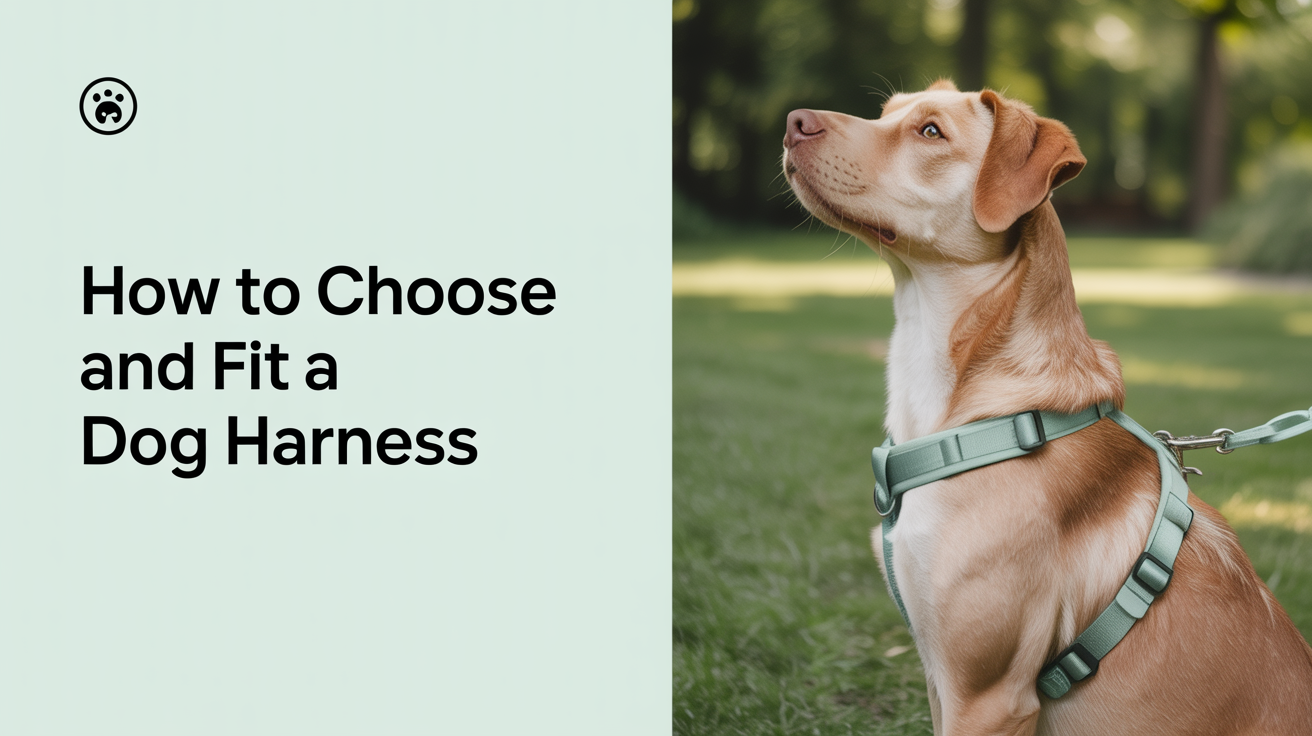
A well-fitted harness distributes pressure across the chest and shoulders instead of the throat, which matters a lot for dogs who pull or have any tracheal sensitivity. Knowing how to fit a dog harness correctly takes about five minutes and one tape measure, but getting it wrong means chafing, escape attempts, or a harness that does nothing for leash manners. This guide covers the main harness types, how to measure your dog, and how to dial in the fit once you have it.
At a Glance
- Match the harness type to the dog's behavior and body, not just their size, back-clip for calm walkers, front-clip for active pullers, step-in for head-shy dogs.
- Measure girth (chest circumference, just behind the front legs) and neck before shopping; girth is the number that matters most.
- Use the two-finger rule on every strap, not just the main chest band, and re-check after the first few walks for rubbing.
- Introduce the harness gradually with food, the same patience that works for crate training works here.
- A harness is a management tool, not a training program, pair it with real leash work.
- Recheck fit every few weeks during a puppy's growth spurts, and replace at the first sign of frayed webbing or failing hardware.
Which harness type fits your situation
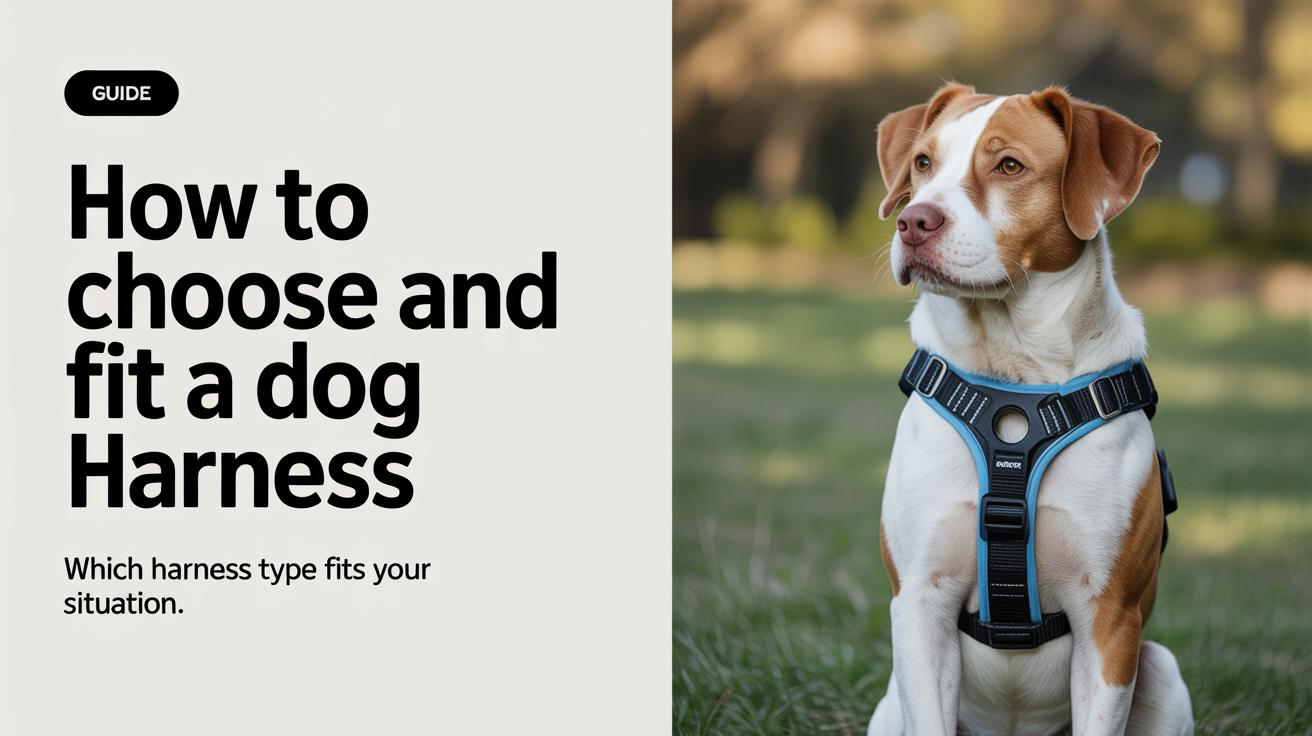
There's no single best dog harness type, it depends on your dog's body, behavior, and what you're trying to accomplish. The Cummings School of Veterinary Medicine at Tufts is blunt about the baseline choice: "harnesses, provided they are well fitted, are much preferable to collars for dogs for leash walking," in large part because a harness keeps repeated leash pressure off the neck and throat, where collars concentrate it. Within that broad recommendation, though, harness style still needs to match the dog.
Back-clip harnesses
The leash attaches to a ring between the shoulder blades. These work well for dogs who already walk nicely and for small dogs where throat pressure is a concern. The downside: they give you almost no leverage if your dog pulls, and for some dogs the back clip actually increases pulling by triggering an opposition reflex (think sled dog).
Good for: calm adult dogs, small breeds, puppies getting used to gear.
Front-clip (no-pull) harnesses
The leash clips to a ring on the chest. When the dog pulls forward, the chest ring turns them sideways instead of letting them power ahead. This doesn't stop pulling on its own, but paired with basic leash training it makes a real difference. The Easy Walk and Freedom Harness are common examples.
Good for: dogs actively working on leash manners, strong pullers.
Dual-clip harnesses
These have both a chest ring and a back ring. You can use either, or a coupler that attaches to both for maximum control. Flexible and worth the slight extra cost if you're unsure which clip works better for your dog.
Good for: dogs in training who may outgrow pulling; owners who want one harness for multiple uses.
Step-in harnesses
The dog steps into two loops and you clip the back. No over-the-head fuss. Popular for dogs who dislike things going over their face, but the fit can be tricky on very deep-chested or barrel-chested dogs (think Bulldogs, Basset Hounds).
Good for: head-shy dogs, small to medium breeds with average proportions.
Vest/padded harnesses
A wider body panel distributes pressure even more broadly. Good for dogs recovering from injury, senior dogs, or small dogs whose owners carry them often. Less ideal for heavy pullers because the extra surface area can make the dog feel "anchored" and harder to redirect.
Good for: seniors, post-surgery dogs, toy breeds.
Which type, at a glance
| Harness type | Best for | Main tradeoff |
|---|---|---|
| Back-clip | Calm walkers, small dogs, puppies new to gear | Little leverage on a strong puller |
| Front-clip (no-pull) | Dogs actively learning leash manners | Chest strap can migrate if not fitted tightly |
| Dual-clip | Dogs whose pulling level is still changing | Slightly higher cost, more straps to adjust |
| Step-in | Head-shy dogs | Fits poorly on deep-chested breeds |
| Vest/padded | Seniors, post-surgery, toy breeds | Extra surface area can anchor a heavy puller |
How to measure your dog for a harness
Before buying anything, grab a soft tape measure. Most harness sizing is based on two numbers.
Girth (chest circumference): Measure the widest part of the rib cage, just behind the front legs. Keep the tape snug but not tight, a finger of slack is fine. This is the most important measurement. If your dog is between sizes, size up.
Neck: Measure around the base of the neck, where a collar would sit. Not all harnesses need this, but some over-the-head styles do.
Write both numbers down before shopping. Manufacturer sizing charts vary a lot, so a "medium" in one brand might be a "small" in another.
| Dog size | Typical girth range | Common breeds in this range |
|---|---|---|
| XS | 12–16 in (30–41 cm) | Chihuahua, Yorkshire Terrier |
| S | 16–22 in (41–56 cm) | Beagle, Corgi, French Bulldog |
| M | 22–27 in (56–69 cm) | Border Collie, Cocker Spaniel |
| L | 27–33 in (69–84 cm) | Labrador, Boxer, Husky |
| XL | 33–42 in (84–107 cm) | Rottweiler, Great Dane, Bernese |
These are rough guides. Always cross-reference with the specific brand's chart, especially for brachycephalic breeds (Pugs, Bulldogs) or deep-chested breeds (Greyhounds, Whippets) that often need a size up in girth.
How to fit a dog harness once you have it
This is where most people run into trouble. A harness on the shelf never fits perfectly; adjustment takes a minute or two.
The two-finger rule: Across every strap, you should be able to slide two fingers underneath without forcing them, but the strap shouldn't be loose enough to bunch or shift. Apply this check to every adjustable strap, not just the main chest band.
Check the chest plate position: On a front-clip harness, the chest piece should sit flat on the sternum, not riding up into the throat, not sliding down below the arm pits. If it's migrating, the shoulder straps need shortening or the girth band needs tightening.
Check shoulder clearance: The straps crossing the shoulders shouldn't dig into the shoulder joint when the dog walks or reaches forward. Watch your dog take a few steps. If the harness looks like it's limiting the front leg swing, the shoulder straps are too tight or sitting too far forward.
Check the girth band: This sits just behind the front legs. It should be snug enough that the harness doesn't rotate when the dog moves, but not so tight it compresses the ribs. You should see the dog breathe normally.
Look for rubbing spots: After the first few walks, check the armpits and the area just behind the front legs. Red marks or hair loss means friction, either the harness doesn't fit the body shape, or the straps need repositioning.
Introducing the harness to your dog
Some dogs accept a harness immediately. Others need a few days. The process is straightforward: put the harness near the dog's bowl or bed so they get used to the sight and smell of it. Then briefly put it on, give a treat, take it off. Repeat that a few times before attaching a leash.
Never force a head-shy dog to have a harness jammed over their face, a step-in style solves the problem outright. If your dog is generally anxious about gear, moving slowly and pairing each touch of the harness with food usually gets you there within a week.
This is different from crate introduction but shares the same logic, patience and positive association beat forcing the issue. If you're also working on crate training, the same gradual approach applies (see our guide to choosing the right crate size and type).
When a harness isn't enough on its own
A no-pull harness is a management tool, not a training program. It makes walks more manageable while you teach leash manners, but if you only use the harness and never work on the underlying behavior, most dogs will go straight back to pulling the moment they're on a flat collar.
The basic idea: reward your dog for walking near you with a loose leash. Stop moving when the leash gets tight. Direction changes when pulling starts. It's repetitive and requires consistency, but it works. A front-clip harness just makes that process less physically exhausting while you're in the middle of it.
The American Veterinary Society of Animal Behavior's position statement on humane training is worth knowing here too: it recommends reward-based methods over aversive equipment and corrections, and a well-fitted no-pull harness fits squarely into that reward-based approach because it removes discomfort and lets you reinforce the walking pattern you actually want, rather than relying on a correction to stop the one you don't.
For a broader overview of all your leash and collar options, including long lines for recall work, the collars, leashes, and long lines explained guide covers each piece of equipment and when to use it.
Signs it's time to replace or resize
Harnesses wear out and dogs change size. Check yours every few months.
- Webbing fraying, especially near clip attachment points
- Buckles that don't click firmly or release too easily
- Stitching separating where the leash ring is attached
- Puppy or adolescent dog who's gained significant weight, measure again before assuming the harness still fits
- Persistent rub marks that don't resolve with strap adjustment
A harness with failing hardware is a safety issue. A dog can slip out of a loose harness even if they never have before.
While you're auditing gear, it's worth checking your dog's sleeping setup too, worn-out beds create pressure points just like ill-fitting harnesses. Finding a dog bed that actually holds up is a quick read if yours is overdue for replacement.
Frequently asked questions
How tight should a dog harness be?
The standard check is the two-finger rule: two fingers should slide under any strap without forcing, but the harness shouldn't shift or rotate when the dog moves. If you can fit three fingers easily, it's too loose. If you can barely get one in, it's too tight. The girth band is most important to get right, a strap that's too tight across the ribs restricts breathing.
Can puppies wear harnesses?
Yes, and they're generally better than collars for puppies, whose tracheas are still developing. The fit will need to be checked every few weeks during rapid growth phases (roughly 8–20 weeks for most breeds). Buy a harness with multiple adjustment points so you get more use out of it before sizing up.
Will a no-pull harness stop my dog from pulling?
It reduces pulling significantly for most dogs because the front clip redirects them sideways instead of forward. But it works best alongside leash training, not as a substitute. Dogs who've been pulling for years usually take a few weeks of consistent work before the improvement becomes obvious.
My dog slips out of every harness. What should I try?
Some dogs, Greyhounds, Whippets, Salukis, Dachshunds, have narrow heads relative to their neck and chest, which makes standard harnesses easy to back out of. Look for escape-proof or "martingale" harnesses with a strap that crosses the back just behind the shoulders, creating a Y-shape that tightens slightly under pressure. Roman-style harnesses that form a full H or X across the back also work better for escape artists.
How do I clean a dog harness?
Most webbing harnesses can be hand-washed with mild dish soap and warm water, then air-dried away from direct heat. Check the label first, some padded or neoprene styles can go in a mesh bag on a gentle machine cycle. Don't machine-dry any harness; heat degrades the webbing and plastic buckles faster. Clean it when it's visibly dirty or smells, and check the hardware while you're at it.
Should I ever use both a harness and a collar at the same walk?
Many trainers recommend exactly that: harness for the leash attachment (where the physical control happens) and a well-fitted flat collar for the ID tag and rabies tag. That way, if the harness ever slips or you need a quick backup point of control, your dog still has ID on them, and you're never relying on the collar alone to hold a pulling dog.
Is a harness safe for a dog with a heart or breathing condition?
Generally yes, and often safer than a collar, since it avoids direct pressure on the trachea and the carotid area of the neck. That said, a harness with a tight girth band can still restrict a dog's breathing if it's fitted too snugly across the ribcage, so for any dog with a diagnosed cardiac or respiratory issue, have your vet or a vet-trained fitter check the fit directly rather than guessing from a size chart alone.