Gear & Essentials
Choosing the Right Crate Size and Type
How to choose the right crate size and type for your dog, compare wire, plastic, and soft crates, and size a crate that grows with a puppy.
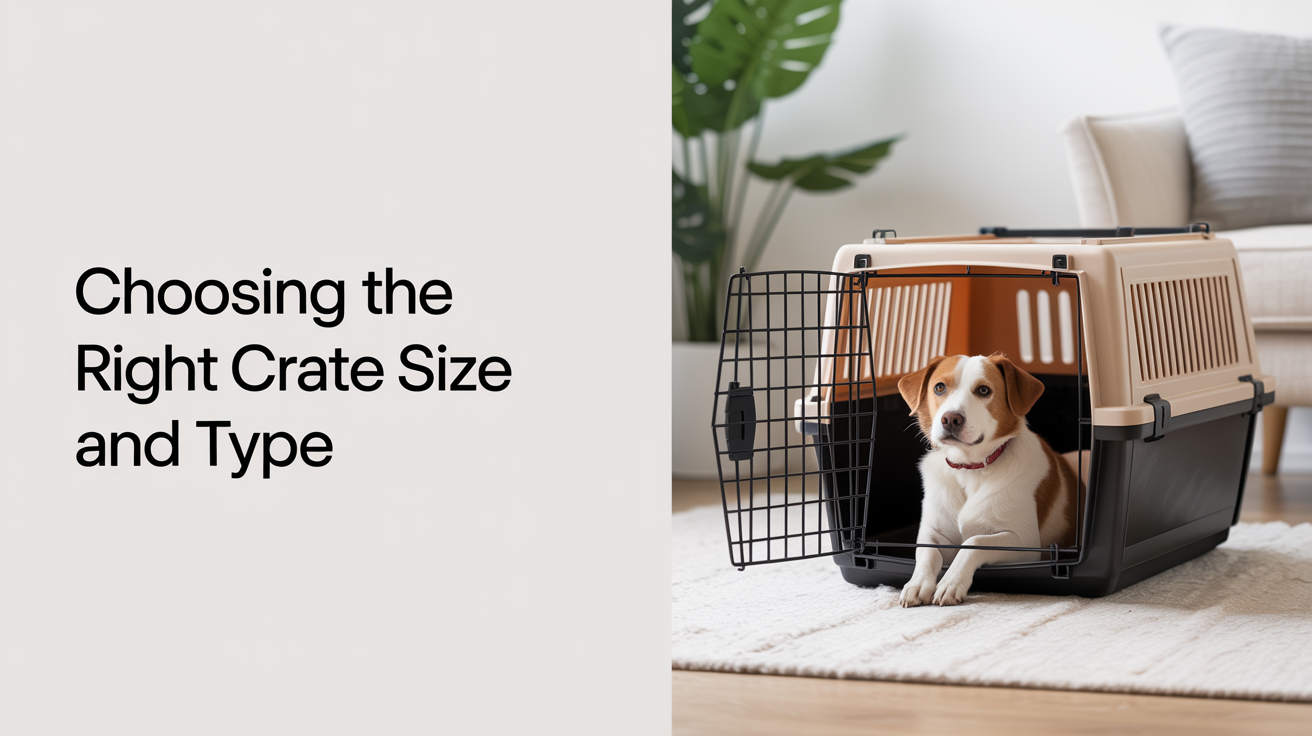
The right crate makes training easier and gives your dog a place they actually want to be. The wrong one makes housetraining harder, wastes money, and leaves your dog either cramped or using the far corner as a toilet. This dog crate size guide covers how to measure correctly, which crate type suits which dog, and how to avoid the most common buying mistakes.
At a Glance
- Size for stand, turn, and lie flat, nothing more. A crate that's too roomy for an untrained dog undermines housetraining.
- Buy a puppy's adult-size crate up front and use the divider panel rather than buying twice.
- Wire suits airflow and visibility; plastic suits den-like privacy and air travel; soft crates are for trained dogs only.
- Location matters: floor level, out of direct sun and vents, close enough to hear the household.
- Build a positive association over days, not hours, before you ever need the crate to hold a dog on its own.
- Four to five hours is the general daytime ceiling for an adult; puppies need far more frequent breaks based on age.
How to size a crate
The rule is simple, and it matches the Humane Society's crate-selection guidance: your dog should be able to stand up without their head grazing the ceiling, turn around in a full circle, and lie flat on their side with their legs stretched out. That's it. You're not looking for square footage, you're looking for a snug, den-like space. Ohio State's veterinary-run Indoor Pet Initiative describes the same target: a crate "large enough in which your pup can sit, stand, turn around, and lay down comfortably on her side," while cautioning that going bigger just to be generous works against you during housetraining.
To measure, get your dog standing naturally and measure from:
- Floor to top of head (or tips of ears if they stand erect) for height
- Tip of nose to base of tail for length, then add 2-4 inches
Those two numbers tell you what crate dimensions to look for. Most manufacturers list interior dimensions on product pages; don't trust the "fits a large breed" tag without checking the numbers.
Why you don't want too much space
A crate that's too big for an untrained dog defeats the purpose. Dogs won't soil their sleeping area if there's no room to sleep at one end and eliminate at the other. A puppy in an adult-sized crate will treat the back corner like a separate room. Most wire crates come with a divider panel for this reason, use it.
Sizing for a puppy
If you have a puppy, buy for their adult size and use the divider to block off extra space. You'll need a rough estimate of their adult weight. Breed standards give a reliable range for purebreds. For mixes, a DNA test or a vet's assessment of bone structure at 8-12 weeks gives a working estimate. Buying a puppy crate that fits only them now means buying again in six months.
The table below shows adult weight ranges and the crate sizes they typically call for:
| Adult weight | Crate size (length) | Common breeds in range |
|---|---|---|
| Under 25 lbs | 24 in | Chihuahua, Maltese, small Dachshund |
| 25-40 lbs | 30 in | Beagle, Cocker Spaniel, Corgi |
| 40-70 lbs | 36 in | Border Collie, Bulldog, Pit Bull |
| 70-90 lbs | 42 in | German Shepherd, Labrador, Golden Retriever |
| 90+ lbs | 48 in | Great Dane, Mastiff, Saint Bernard |
These are starting points. A stocky Bulldog at 50 lbs may need a wider crate than a lean Whippet at the same weight. Measure your actual dog rather than trusting the category alone.
Wire vs plastic crate: which to pick
The two most common crate materials each have a clear use case. Neither is universally better.
Wire crates
Wire crates fold flat, have better airflow, and let your dog see the room, which some dogs prefer and others find overstimulating. The panels are adjustable or removable to change the configuration. Most have a removable plastic tray at the bottom that's easy to clean.
Good fit for: dogs that tend to run hot, dogs that get anxious in confined spaces, homes where the crate moves between rooms frequently, and anyone who wants one crate to last from puppyhood to adulthood using the divider.
Watch out for: escape artists. A dog that's motivated can work wire panel latches. If you have a dog that pulls or chews at the wire, the seams can loosen over time.
Plastic crates (airline-style)
Plastic crates have solid walls and a vented door. They feel more den-like, which suits dogs that are easily distracted or want more privacy. They're also IATA-compliant for air travel if you fly with your dog.
Good fit for: anxious dogs that calm down when visual stimulation drops, air travel, and dogs that self-soothe by being in a darker space.
Watch out for: airflow. In warm climates or without AC, the enclosed design can get stuffy. They also don't fold, storage is awkward.
If you're buying for air travel specifically, the sizing math is stricter than a home crate. Airlines generally require your dog to stand at full height without touching the top, turn around freely, and lie down with legs extended, the same core rule, but they also want visible proof of it: measure nose-to-base-of-tail and add a few inches for length, then measure standing height including the ears if they're erect, and check that both numbers clear the airline's stated minimum with room to spare. A crate that just barely fits at home can get rejected at check-in if it's measured tighter than the carrier's own chart allows, so buy slightly larger than the bare minimum if flying is a real possibility.
Soft crates
Soft-sided crates with mesh panels are lightweight and portable. They work well for travel, dog shows, or well-trained dogs that don't chew or scratch. They're not suitable for puppies in training or any dog that pushes against boundaries, the zippers and fabric won't hold a dog that's motivated to leave.
Heavy-duty crates
If your dog has destroyed wire or plastic crates before, there are welded steel options that can take a lot of force. They're expensive and heavy, but for dogs with genuine separation anxiety or a history of crate damage, they're worth considering. This is a safety issue more than a training one, a dog that injures itself trying to escape a crate needs both a more secure crate and help addressing the anxiety, so involve your vet or a certified behavior consultant.
Comparing the four crate types at a glance
| Type | Airflow | Portability | Escape resistance | Best use case |
|---|---|---|---|---|
| Wire | Excellent | High (folds flat) | Moderate | Home use, dogs that want to see the room |
| Plastic (airline) | Fair | Moderate (doesn't fold) | Good | Air travel, anxious or privacy-seeking dogs |
| Soft-sided | Poor to fair | Excellent | Low | Trained, calm dogs; travel, shows |
| Heavy-duty steel | Good | Low (heavy) | Excellent | Destructive dogs, severe separation anxiety |
Where to put the crate
Location matters more than people expect. A crate shoved in a utility room away from the household sends a different message than one in the corner of the living room where the dog can still see and hear the family.
For most dogs, aim for:
- A spot that gets regular household foot traffic but isn't in the middle of everything
- Away from heating vents and direct sun, which can make the interior too hot
- At floor level, dogs find a raised crate unstable
If your dog is crate-trained overnight, keeping the crate in or near the bedroom helps with separation anxiety and makes it much easier to hear a puppy signal that they need to go out.
Crate placement pairs with other gear choices. If your dog sleeps in the crate but spends time in other rooms during the day, a good dog bed that holds its shape over time gives them a second settled space outside the crate.
Setting up the crate interior
The inside should be comfortable but not cluttered. For a puppy or new rescue, start minimal:
- A thin, washable mat or folded towel (not a thick bed they might soil and then ignore)
- A chew item appropriate for their age and chewing style
- No water bowl unless they'll be crated for more than a few hours, spills make the bedding wet and some dogs tip bowls for entertainment
Covering three sides of a wire crate with a blanket or purpose-made crate cover reduces visual stimulation and helps dogs settle. Leave the door side open for airflow.
Skip stuffed toys for puppies in the crate unsupervised, the stuffing is an ingestion risk if they're a determined chewer. A rubber Kong stuffed with food works well because it keeps them busy and there's no loose material.
Getting your dog comfortable with the crate
No matter which type you buy, a dog that's been rushed into a crate will resist it. The crate itself isn't the problem, the association is. Build a positive one before you need the crate to do any work.
Start with the door off or propped open. Toss treats in casually throughout the day. Feed meals near the crate, then in the doorway, then inside. Work up to closing the door for 30 seconds while you're visible, then a few minutes, then longer. This takes days, not hours, for most dogs. Don't skip steps because your schedule is tight.
If you're also working on walking your dog calmly on leash, the crate gives you a safe place to leave them while you prep gear, and a dog that's learned to settle in a crate is usually easier to manage in the rest of the house too.
Puppies can hold their bladder for roughly one hour per month of age, up to a maximum of about four hours during the day (and somewhat longer overnight as they mature). A 10-week-old needs a bathroom break every two hours at most. Crating longer than their capacity and then correcting accidents is counterproductive, they can't hold it.
For dogs that already have negative associations with a crate from a shelter or prior home, go even slower and pair every crate interaction with high-value food. If a dog is showing panic, panting, drooling, trying to force out of the crate, that's not stubbornness, that's distress. The ASPCA is direct about this: if a dog shows heavy panting, excessive salivation, frantic escape attempts, or persistent howling when crated, "crate confinement isn't the best option for him," and a baby-gated room is a better fallback than forcing the issue. Talk to your vet or a certified applied animal behaviorist before continuing in either case.
Frequently asked questions
What if my dog lies diagonally, should I size up?
Some dogs sprawl sideways or in odd positions. If your dog reliably does this and can't comfortably fit using the standard measuring method, go up one size. That said, for a dog in active housetraining, a larger crate usually makes accidents more likely, it's a tradeoff. Once your dog is reliable in the house, you can give them more space.
Can I use the crate as punishment?
No. Sending a dog to their crate after they've done something wrong teaches them to associate the crate with your anger, which is the opposite of what you want. The crate should always be voluntary and positive. If you need them out of the way briefly, ask for a "place" or "go to mat" cue instead.
How long is too long to leave a dog crated?
For adult dogs, the general ceiling is four to five hours during the day. Longer than that and you're asking a dog to be sedentary in a small space for most of their waking hours, which affects both welfare and behavior. Overnight is different, most adult dogs sleep through an eight-hour night without issue. Puppies need more frequent breaks, as noted above.
My dog whines in the crate at night. What do I do?
First, rule out a real need, do they need to go outside? If they've been out recently and are otherwise healthy, the whining is likely about adjusting to the crate. Don't let them out in response to whining, or you've taught them that whining opens the door. Wait for a break in the noise, even a few seconds of quiet, then calmly let them out. Moving the crate closer to your bed so they can hear you breathe often cuts nighttime whining significantly.
Is it cruel to crate a dog?
A crate used correctly, for a reasonable length of time, with positive associations, and as one part of a broader training plan, is not cruel. Many dogs actively seek out their crates to rest. The issues arise when crates are used as a substitute for exercise and attention, or when dogs are left far longer than they can reasonably cope. The crate is a tool; what you do around it matters as much as the crate itself. A dog that has enough exercise, interaction, and mental stimulation during the day will settle in a crate readily. One that doesn't, won't, and that's worth addressing directly. If your dog also needs a good harness for daily walks, getting that sorted improves the whole routine.
Should two dogs share one crate?
Generally, no, even if they're closely bonded. Two dogs in one crate can't both fully stand, turn, and lie flat, and confinement stress in one dog can quickly become a resource-guarding trigger for the other. Buy separate, correctly sized crates and place them near each other if the dogs are used to sleeping close by. The exception is very young littermates for a short window, and even then, most trainers recommend splitting them before 10-12 weeks so each dog learns to settle independently.
How do I transition a dog off the crate entirely once they're reliable?
Most owners do this gradually rather than all at once. Once a dog has gone months without an accident or destructive episode while crated, try leaving the crate door open during a short errand while you're still nearby (or home in another room), then extend the away-time. Keep the crate available and set up as a bed even after your dog no longer needs the door closed, many dogs keep choosing to sleep in it voluntarily for years.