Grooming & Coat Care
Bathing Your Dog at Home: A Simple, Low-Stress Routine
A simple, low-stress routine for bathing your dog at home: how often to bathe, what shampoo to use, water temperature, and drying without the chaos.
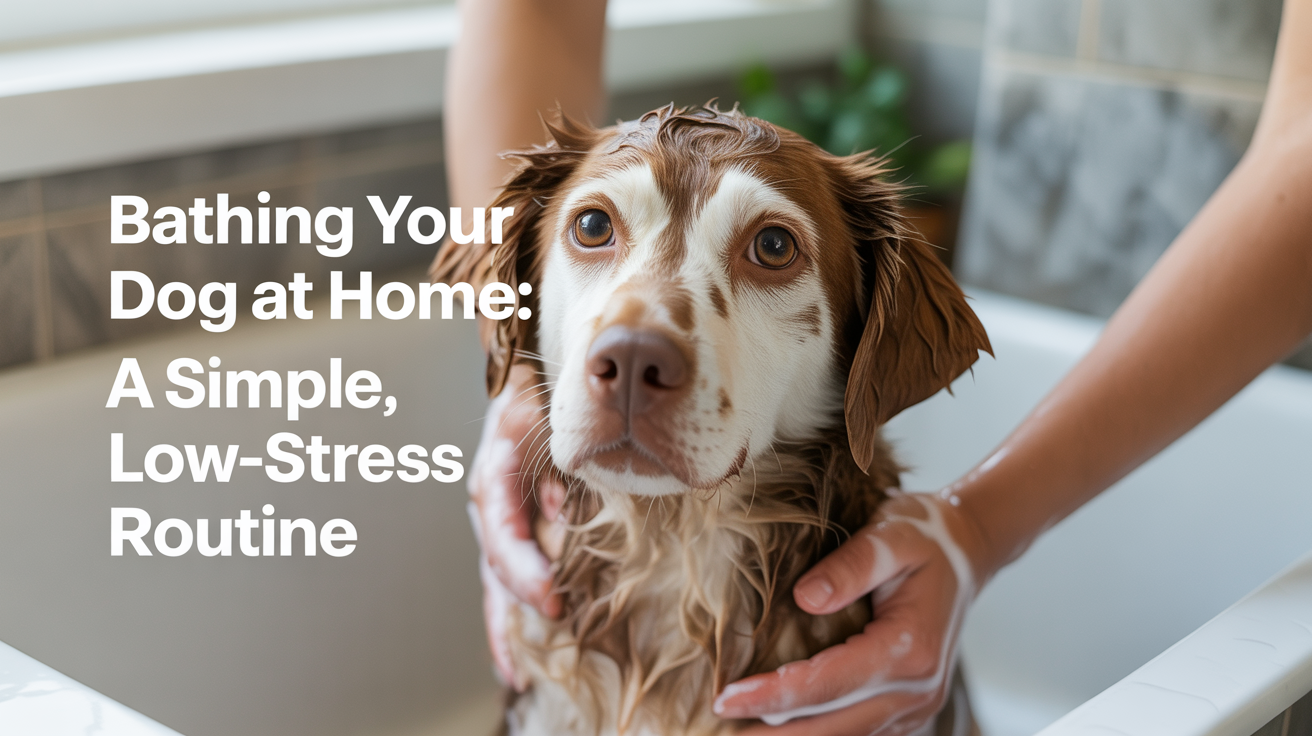
Most dogs need a bath every four to six weeks, not weekly, not whenever they smell a little off. Learning how to bathe a dog at home well comes down to a short setup routine, the right water temperature, and not rushing the rinse, and the Humane Society's at-home bathing walkthrough lands on the same short list of essentials. Get those three things right and your dog will probably tolerate it a lot better than you expect.
How often to bathe a dog
Coat type and lifestyle matter more than any fixed calendar. A Labrador who swims twice a week needs more frequent washing than a Maltese who mostly sits on the couch. Active outdoor dogs or dogs with skin conditions may need baths every one to two weeks; heavy double-coated breeds like Huskies often do fine with a bath every six to eight weeks.
Bathing too often strips the coat of natural oils, which leads to dry, flaky skin. Bathing too rarely lets bacteria and yeast build up, especially in skin folds or around the ears. A simple smell-and-feel check works: if the coat smells stale or feels greasy, it's time. If it still smells clean after a quick rub, you can wait.
| Coat type / situation | Suggested frequency |
|---|---|
| Short, smooth coat (Beagle, Boxer) | Every 4-6 weeks |
| Long or silky coat (Spaniel, Setter) | Every 3-4 weeks |
| Double coat (Husky, Shepherd) | Every 6-8 weeks |
| Wire or terrier coat | Every 4-6 weeks |
| Dog with skin allergies | Weekly or per vet advice |
| Dog who swims or rolls in mud regularly | As needed, up to weekly |
If your dog has a skin condition, recurring yeast infections, or a coat that tangles fast, it's worth checking with your vet before settling on a schedule. What works for one dog won't automatically work for another.
What you need before you start
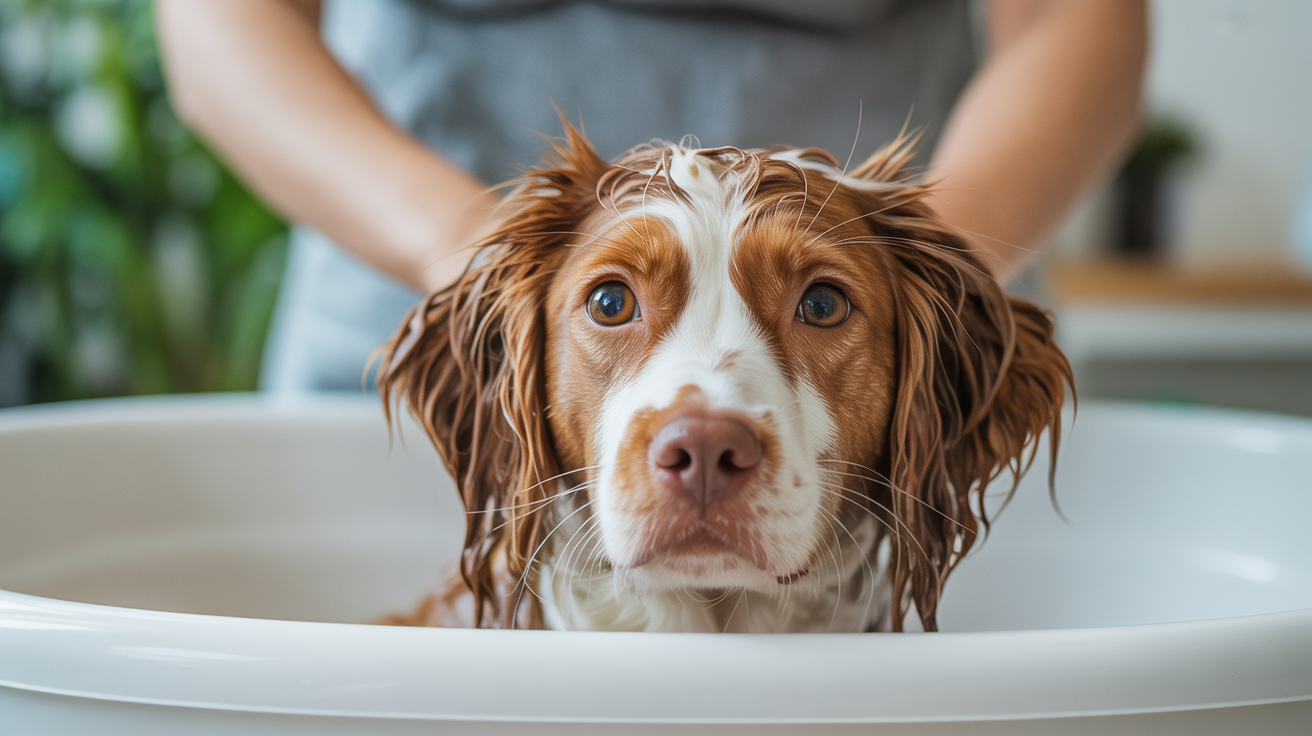
Getting everything in arm's reach before you wet the dog is the single biggest quality-of-life improvement for this whole process. Once a wet dog decides to bolt, you're chasing them through the house.
- Dog shampoo (more on this below)
- Two towels, one for the initial squeeze-down, one for the finish
- A non-slip mat for the tub or shower floor
- A handheld shower attachment or a plastic pitcher for rinsing
- Cotton balls (optional, but useful for ear protection)
- A brush for post-bath detangling
If your dog is larger than about 30 pounds and you're bathing them in a regular tub, a rubber bath mat is not optional. Slipping is a real risk and a scared, scrambling dog makes the whole experience worse for both of you.
Before you run the water, give your dog a quick brush-through. Mats that are wet become almost impossible to work out, and a loose-fur-heavy dog will shed a lot of that coat in the rinse, which can clog your drain. For dogs with particularly dense or tangled coats, check out how to brush your dog based on their coat type before you start.
Picking a shampoo
The best dog shampoo basics come down to two rules: use a product made for dogs, and match it to your dog's skin and coat.
Human shampoos have a different pH than dog shampoos. Dogs' skin runs around 6.2 to 7.4 pH; most human shampoos are formulated for lower pH (around 4.5 to 5.5). Using human shampoo repeatedly will dry out your dog's skin and disrupt the skin barrier.
- For most dogs: A basic, unscented or lightly scented dog shampoo with no artificial dyes. Look for a short ingredient list.
- For itchy or sensitive skin: Oatmeal-based shampoos work well and are widely available. Avoid anything with alcohol high in the ingredient list.
- For dogs with recurring skin infections: Medicated shampoos (chlorhexidine, miconazole) are available over the counter. If your dog has a diagnosed yeast or bacterial issue, your vet may prescribe something specific.
- For white or light coats: Brightening shampoos can help with staining, but avoid ones that contain optical brighteners if your dog has sensitive skin.
Conditioner is worth considering for dogs with longer or coarser coats, it makes detangling easier and reduces static. Apply it after the shampoo rinse, wait a minute or two, then rinse it out fully.
The bath itself
Water temperature is where a lot of people go wrong. Lukewarm, roughly 38°C (100°F), close to body temperature, is the right target. Hot water can burn a dog's skin and sends most of them into immediate panic mode. Cold water works but makes the whole experience unpleasant, which makes future baths harder.
Run the water and check the temperature on your wrist before your dog gets in.
Wetting the coat: For short coats, a quick all-over soak takes about 30 seconds. For thick double coats, you may need a full two minutes to saturate down to the skin. Use your fingers to work the water through, starting at the back and working toward the head.
Applying shampoo: Start at the neck and work toward the tail. Avoid the face entirely for now. For the face, use a damp cloth or a very diluted amount of shampoo on your fingers, never pour shampoo over the head, because you'll get it in the eyes and ears.
Ears are worth a quick mention: water in the ear canal can cause infections, especially in floppy-eared breeds. You can place a cotton ball loosely in each ear before the bath to help. After the bath, check the ears and dry around them well. If you notice redness, a bad smell, or your dog shaking their head a lot, read up on how to clean your dog's ears safely.
Rinsing: This is where most people cut it short. Shampoo residue left in the coat causes itching and skin irritation, which makes your dog associate baths with discomfort. Rinse twice as long as you think you need to. Run your fingers through the coat while rinsing to make sure you're getting soap out from near the skin, not just off the surface.
Drying without the chaos
The post-bath scramble is real. Dogs shake instinctively as soon as they get out, and on a cold day a damp dog can get chilly fast. Here's how to handle it without the house getting soaked:
- While your dog is still in the tub, do a first pass with your hands, squeeze water out of the legs and belly rather than just patting.
- Wrap them in the first towel while they're still contained and press (don't rub) the coat to absorb the bulk of the water.
- Let them shake, they will anyway, so doing it before they're fully dry and out of the tub saves your walls.
- Use the second towel for a follow-up dry.
For dogs with thick coats, towel drying alone won't be enough. A hand-held hair dryer on the lowest heat setting works, but keep it moving and hold it at least 15 cm from the coat. Many dogs are initially nervous about the dryer; let them sniff it while it's off, then run it near them before pointing it at them. High heat is a burn risk, so if you're not sure, skip the dryer and just keep the dog warm inside until they air-dry.
After drying is a good time to check the nails, wet nails are slightly softer and easier to see the quick in. If trimming is on your list, how to trim dog nails without the stress walks through the process.
Give your dog a treat when it's over. Not as a bribe during the bath (that can reinforce anxious behavior), but as a calm end-note. You want "bath time ends, good thing happens" to be the consistent association.
Frequently asked questions
Can I use baby shampoo on my dog in a pinch?
Baby shampoo is gentler than regular human shampoo, and in a genuine emergency (your dog rolled in something and you have nothing else on hand) it won't cause serious harm once. But it's still formulated for human skin pH, so regular use will dry out the coat over time. Keep a bottle of actual dog shampoo around and use that as the default.
My dog hates baths, how do I make it less of a fight?
Start smaller than you think necessary. If your dog is bath-averse, spend a few sessions just getting them comfortable standing in the dry tub with a high-value treat before you add water. Then run water near them. Then wet just the paws. Gradual exposure over several days works better than one difficult bath. Never force or restrain a dog harshly, that makes the fear worse each time.
How do I bathe a puppy for the first time?
Keep the first few baths short, warm, and as calm as possible. Use a small tub or sink, lukewarm water, and a puppy-formulated shampoo (lower concentration than adult formulas). The goal with the first two or three baths isn't thoroughness, it's building a neutral-to-positive association. Ten minutes of gentle, warm washing with lots of quiet praise beats a thorough bath that leaves your puppy terrified of the word "bath" for the next decade.
What if my dog still smells after a bath?
A dog who smells off again within a day or two of a bath usually has a skin issue rather than a cleanliness one. Yeast and bacterial overgrowth both produce persistent odor that shampoo doesn't fix long-term. Check between skin folds, under the ears, and around the tail. If the smell is coming from those areas or your dog is scratching more than usual, a vet visit will get to the cause faster than trying different shampoos.
Do I need a conditioner?
Not always, but it helps for coats that mat or tangle. Short-coated dogs generally don't need it. For a Cocker Spaniel, a Golden, or any dog with a longer or drier coat, a leave-in or rinse-out conditioner after shampooing makes brushing easier and reduces breakage. Apply from mid-shaft to ends rather than right at the skin to avoid weighing down the coat or clogging follicles.