Grooming & Coat Care
How to Brush Your Dog Based on Their Coat Type
How to brush your dog the right way for their coat, from smooth to double to curly, plus the tools and routine that keep shedding and mats down.
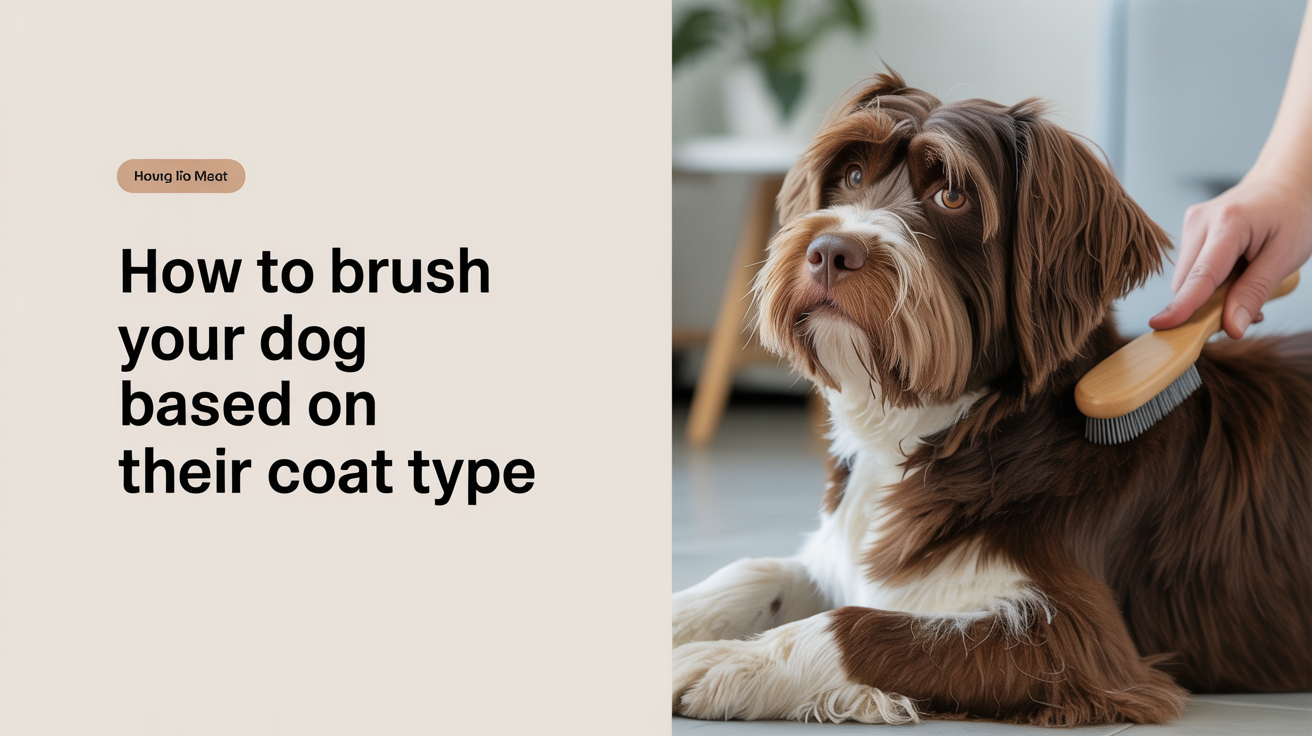
How to brush a dog correctly depends almost entirely on what kind of coat they have. A rubber curry comb that works great on your Beagle will barely touch the undercoat of a Husky, and dragging a slicker brush through a dry Poodle coat can snap the curls and cause breakage. Get the right tool and the right technique for your dog's coat, and brushing becomes quicker, more effective, and a lot less miserable for both of you.
Why coat type matters more than breed labels
Pet supply packaging often sorts dogs into "short-haired" and "long-haired," which misses a lot. The texture, density, and layer structure of a coat determine what tools penetrate it and what motion moves dead hair out without damaging the skin or live coat.
There are five main coat structures:
- Smooth/short: Flat, close-lying coat with no undercoat (Boxer, Greyhound, Dachshund)
- Double coat, short outer: Dense undercoat under a short, coarse topcoat (Labrador, Corgi, Beagle)
- Double coat, long outer: Full undercoat under longer guard hairs (Husky, Golden Retriever, Bernese Mountain Dog)
- Silky/flowing: Long, fine hair without a thick undercoat (Afghan Hound, Cavalier King Charles, Yorkshire Terrier)
- Curly or wavy: Non-shedding or low-shedding coat that mats readily (Poodle, Labradoodle, Bichon Frise)
Wire coats (Airedale, Wirehaired Dachshund) are a sixth category but are less common and often handled by professional hand-stripping.
Tools that actually match the job
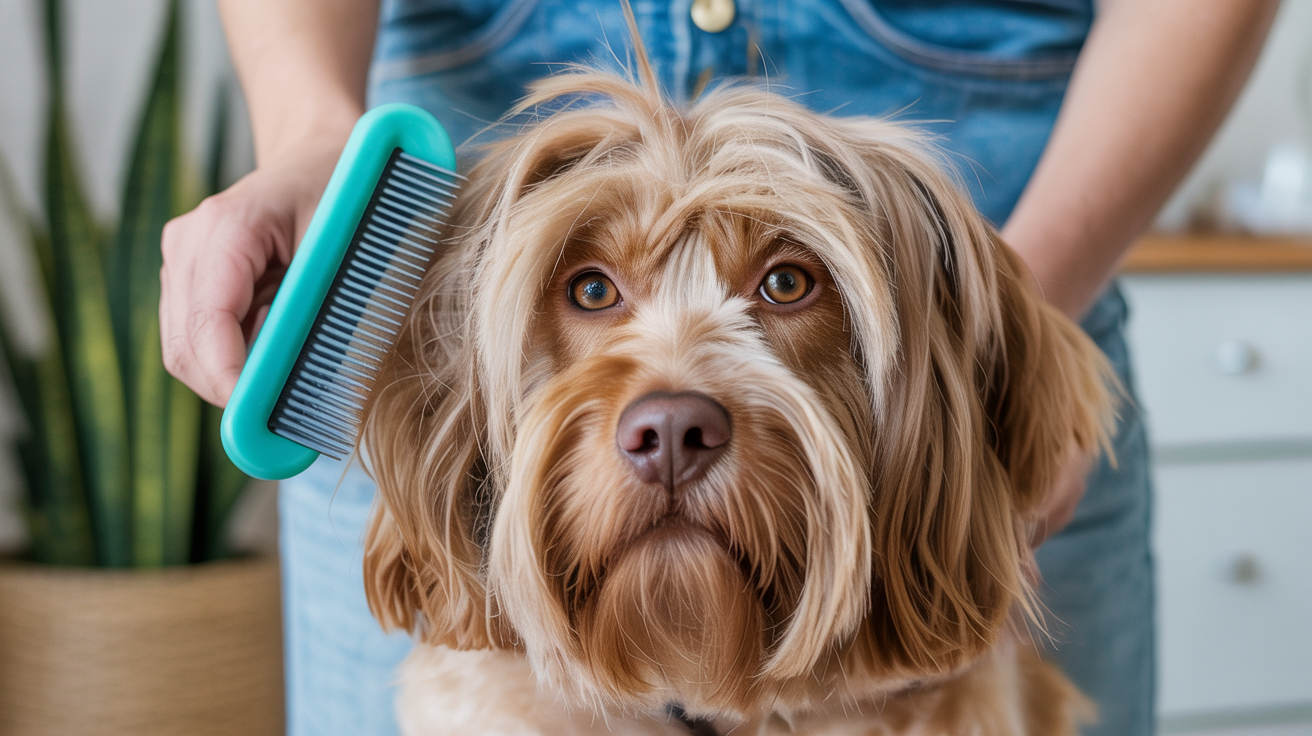
Owning every brush on the shelf is unnecessary. Most dogs need two tools at most.
| Coat type | Primary tool | Secondary tool |
|---|---|---|
| Smooth/short | Rubber curry comb or grooming mitt | Soft bristle brush to finish |
| Double coat (short outer) | Slicker brush | Undercoat rake or deshedding brush |
| Double coat (long outer) | Pin brush | Undercoat rake + metal comb |
| Silky/flowing | Pin brush | Wide-tooth comb |
| Curly/wavy | Slicker brush | Metal comb (fine-tooth) |
A few notes on specific tools:
- Deshedding brush (e.g., Furminator-style): works by reaching through the topcoat to grab loose undercoat. Highly effective on Labs and Huskies during shedding season. Use it gently, 1-2 times per week at most, overuse on a healthy coat strips live hair.
- Metal comb: The finishing test for any coat prone to matting. Run it through areas you've brushed. If it snags, there's still a tangle you missed.
- Rubber curry comb: Underrated for smooth-coated dogs. The nubs loosen dead hair and bring oils to the surface without any risk of scratching.
Brushing a smooth or short coat
Short-coated dogs shed more than most owners expect, but they're the easiest to maintain. A session with a rubber curry comb once or twice a week takes about 3-5 minutes and pulls the loose coat before it lands on your furniture.
Work in small circles all over the body, paying attention to the chest, behind the ears, and the base of the tail where hair can accumulate. Follow with a bristle brush to remove debris and distribute skin oils.
These dogs rarely mat. The main reason to brush them is shedding control and skin health, the massage action of a curry comb stimulates circulation and, as the ASPCA notes, helps spread the coat's natural oils while letting you spot any lumps, ticks, or skin changes while your hands are already moving over the dog.
Brushing a double coat
Double-coated dogs (brushing double coat correctly is where most owners go wrong) have two distinct layers, and both need attention. The undercoat is what blows twice a year in large volumes, but it also builds up between full sheds and can become compacted against the skin if neglected.
Short double coats (Labs, Corgis, Beagles)
A slicker brush works for routine sessions. Use moderate pressure and brush with the grain of the coat, then lift slightly at the end of each stroke to pull the dead undercoat out. For shedding season, swap in a deshedding brush for 1-2 sessions a week. Always follow with a bristle brush to remove the hair sitting on the surface.
Long double coats (Huskies, Goldens, Berners)
Start with a pin brush to move through the topcoat. Then take an undercoat rake and work in sections, using short strokes against the direction of growth to loosen compacted undercoat, then brush back with the grain to clear it. Finish with a metal comb through the feathering on the legs, chest, and tail.
Never use a deshedding tool aggressively on a long double coat during non-shedding periods. During the blow, daily brushing for a few weeks is reasonable. Outside of that, 1-2 times per week is enough.
A key rule: do not shave a double-coated dog to manage shedding. The undercoat and topcoat regulate temperature in both directions. Shaving disrupts that and can permanently change the coat texture. Before a bath, always brush out loose hair first, water mats tangles tighter.
Brushing a silky or flowing coat
Long, silky coats (think Afghan Hound, Cavalier, or Yorkshire Terrier) look high-maintenance but are actually more manageable than a double coat, as long as you brush consistently. The bigger risk with these coats is not volume of shed hair but tangles developing quietly at the skin.
Work in layers. Part the coat and brush from the skin outward in sections rather than skimming along the surface. Surface brushing on silky coats misses the knots close to the body. Start at the ends of the hair and work your way toward the roots, freeing tangles from the bottom up rather than pulling through from root to tip.
Focus on high-friction spots: behind the ears, armpits, the groin, and around the collar. These are where matting prevention matters most on silky coats. Check those areas at every session with a metal comb after brushing.
Brushing a curly or wavy coat
Curly-coated dogs like Poodles and Doodles are often marketed as "low maintenance" because they don't shed much. That's partly true, the loose hair stays in the coat rather than falling on the floor. The trade-off is that retained hair, if not brushed out regularly, forms dense mats that can tighten against the skin and become painful, sometimes requiring a full shave-down to remove safely.
Brush these dogs at least 3 times per week, more if they spend time in water, tall grass, or play rough with other dogs (all of which compact the coat faster).
Use a slicker brush in a methodical grid pattern, small sections, brush to the skin, not just the surface. Follow with a fine-tooth metal comb. If the comb passes through every section cleanly, you're done. If it snags anywhere, go back with the slicker.
The armpits and the base of the ears are almost always where mats develop first. Check them at every session. A mat caught early, when it's still a soft knot, can be worked out with your fingers and a comb. A mat that's been there for two weeks often can't be.
How often to brush, by coat type
| Coat type | Minimum frequency | Heavy shedding season |
|---|---|---|
| Smooth/short | 1x per week | 2x per week |
| Double coat (short) | 2x per week | Daily for 2-4 weeks |
| Double coat (long) | 2-3x per week | Daily for 2-4 weeks |
| Silky/flowing | 3-4x per week | Same (less undercoat to shed) |
| Curly/wavy | 3x per week minimum | 4-5x per week if active outdoors |
These are floor numbers. A dog that swims, hikes in brush, or rolls in dirt will need more attention regardless of coat type.
Making brushing easier for your dog
A lot of dogs who resist brushing were introduced to it badly, too much pressure, too fast, or through a mat that hurt. If your dog has negative associations, go slowly. Start with very short sessions (30 seconds), use treats throughout, and stop before the dog gets stressed rather than pushing through. Build up gradually over a week or two.
Keep the session predictable. Same place, same time of day, same order of body regions. Dogs settle into routines, and a predictable grooming session is less stressful than an unpredictable one.
If you're working through a mat: hold the base of the mat (between it and the skin) with your fingers to prevent pulling on the skin, and work the edges of the mat with a comb rather than attacking the center. Dematting spray can help loosen the fibers. If a mat is tight against the skin, over 2-3 cm, or in a sensitive area, have a groomer or vet handle it.
While you're running your hands over your dog during brushing, it's a natural time to check the ears for redness or odor (see how to clean your dog's ears safely if you find buildup) and check the paws. If the nails are clicking on hard floors, they probably need a trim, trimming dog nails without the stress walks through the process step by step.
Frequently asked questions
My dog has a mixed breed coat, how do I figure out what type they have?
Look at the texture and layers, not the breed label. Part the coat down to the skin. If there's a dense, soft underlayer that's a different texture from the outer hair, it's a double coat. If the coat is uniformly one texture from skin to tip, it's likely single-layer. Curly dogs are usually obvious. When in doubt, a groomer can tell you in about 30 seconds what they're working with.
Can I over-brush my dog?
Yes, with the wrong tool or too much force. Aggressive use of a slicker brush on a single-layer coat, or heavy deshedding brush sessions on a dog that isn't in full shed, can irritate the skin and pull live hair. Two to three passes over an area is enough. If you're getting clean, healthy hair on the brush rather than dead undercoat and debris, stop.
Is it okay to brush a wet coat?
For smooth and short double coats, yes, it won't cause damage. For curly, silky, or long double-coated dogs, it depends. Brushing before a bath is better practice because water causes tangles to bind tighter. If you do brush after a bath, work through while the coat is damp rather than soaking wet, and be gentler than usual. Never brush a matted coat wet.
How do I know if my dog needs a professional groomer?
If the dog has mats you can't work out without causing pain, if the coat is so dense you can't see the skin when you part it, or if the dog is too stressed to tolerate home brushing, a groomer is worth the money. For curly-coated dogs especially, a professional trim every 6-10 weeks makes home brushing sessions much more manageable by keeping the coat at a workable length.
My dog is shedding way more than usual outside of shedding season. Should I be worried?
A seasonal blow is normal twice a year for double-coated dogs. Shedding that's sudden, patchy, or accompanied by skin changes (redness, flakiness, bald spots, scratching) is worth a vet visit. Stress, dietary changes, and a few medical conditions can all cause unusual shedding. If the coat looks and feels healthy and the dog seems comfortable, it's probably just timing, some dogs shed on their own schedule regardless of what the calendar says.