Gear & Essentials
Safe Chews and Toys for Heavy Chewers
A practical guide to the best chews for aggressive chewers: what's safe, what to skip, and how to avoid choking hazards at home.
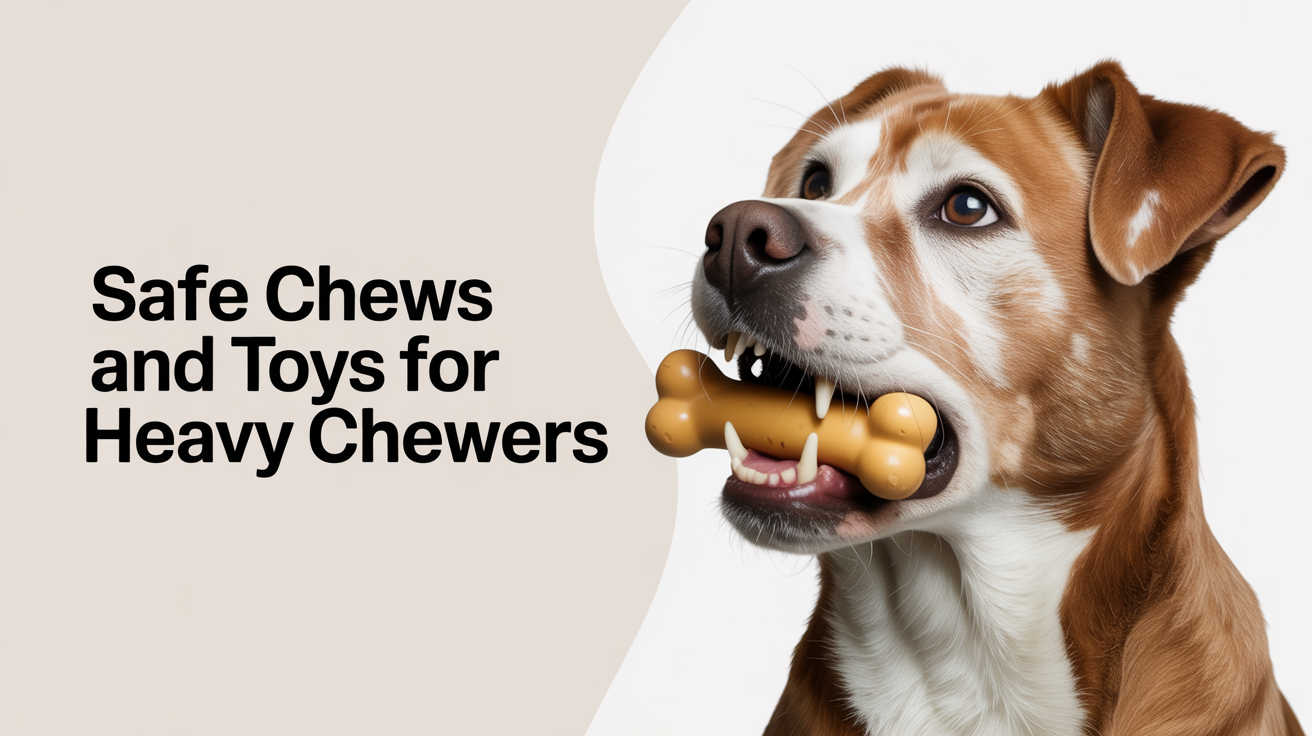
If your dog turns a new chew into confetti within ten minutes, you already know the frustration. The good news is that "heavy chewer" is not a problem to fix; it's a trait to work with. The right chews and durable dog toys keep teeth busy, reduce destructive chewing on furniture, and give your dog a job to do. The wrong ones can splinter, break off in chunks, and become a genuine choking hazard. Here's how to tell them apart.
What Makes a Chew or Toy Safe for a Heavy Chewer
The first thing to understand is the "thumbnail test." Press your thumbnail firmly into the surface of a chew or toy. If it dents, the product has enough give to be safe. If your nail leaves no mark at all, the item is too hard and can crack a molar. Broken teeth are painful, expensive to treat, and entirely preventable.
Beyond hardness, look at a few other factors:
Size relative to your dog. A chew or toy should be large enough that your dog cannot fit the whole thing in the back of their mouth at once. When a dog can get the full object past their molars, the swallowing reflex can take over before they mean it to. A good rule of thumb: the chew should be at least as long as the distance from the tip of their nose to the base of their jaw.
Material integrity. Some chews shed small shards or break into hard, sharp fragments. Others soften and compress as they're gnawed. You want the second type. Watch the first session with any new chew and notice what kind of debris ends up on the floor.
Digestibility. Heavy chewers often swallow pieces whether you want them to or not. If the material is not digestible, those pieces accumulate in the gut. This matters most for synthetic toys and certain natural chews.
Supervision. No chew or toy, however well-made, substitutes for watching your dog, especially with a new product. Once a chew has been gnawed down to a piece small enough to swallow whole, take it away and replace it.
Safe Natural Chews Worth Trying
Natural chews are a practical starting point because most are digestible and have a relatively predictable hardness level.
Bully sticks (pizzle chews). A reliable choice for many heavy chewers. They soften with moisture as your dog chews, which means they compress rather than splinter. The main caution is the calorie count; bully sticks are rich, so factor them into your dog's daily food intake. Use a bully stick holder to prevent your dog swallowing the last nub.
Yak cheese chews (Himalayan chews). Made from compressed dried yak and cow milk, these are very hard initially but soften as they're worked. The "thumbnail test" applies: some varieties are uncomfortably hard for enthusiastic chewers. Start with a medium hardness and watch the first session. One useful feature: when the chew gets too small, you can microwave the last piece to puff it into a cracker-like snack instead of tossing it.
Deer and elk antlers. These often get recommended for heavy chewers because they last a long time. The problem is that antlers sit right on the edge of "too hard." Split antlers expose the softer marrow center and are safer than whole antlers. Still, some dogs chew hard enough on even split antlers to crack a tooth. Watch carefully, and if you see your dog bearing down aggressively on the tip or tine, swap it out.
Collagen chews and tendons. Dried beef tendons and collagen rolls are softer than antlers, usually fully digestible, and last a reasonable amount of time for a moderate-to-heavy chewer. A good middle-ground option.
What to skip: cooked bones of any kind (they splinter into sharp fragments), raw marrow bones cut short ("hockey puck" style), and very small rawhide chips that your dog can fold and swallow. Rawhide itself is a mixed bag; the larger knotted rolls from reputable sources are less risky, but they can still soften and be swallowed in large pieces by a determined dog.
Durable Dog Toys That Hold Up
Not every toy session needs to involve an edible chew. Durable dog toys fill a slightly different role: mental engagement, fetch and tug play, and solo chewing.
Rubber Kong-style toys. Thick natural or synthetic rubber toys designed for heavy chewers exist across several brands. Look for ones labeled "extreme" or "power chewer." Stuffing them with kibble, plain pumpkin puree, or a smear of unsweetened peanut butter (check for xylitol, which is toxic to dogs) extends the session and adds mental work.
Rope toys. Rope toys are fine for supervised tug games, but they are not safe for unsupervised chewing. A determined dog will unravel rope and swallow the strands, which can knot in the intestines. Put rope toys away when play is done.
Nylon and rubber chew sticks. Some dogs respond well to flavored nylon chews. These are not digestible, so the goal is that your dog abrades the surface rather than breaking pieces off. If your dog is strong enough to gouge chunks out of a nylon chew rather than just leaving scratch marks, the product is not suitable for them. Pull it and try a natural chew instead.
Treat-dispensing toys. Puzzle feeders and wobblers are not traditional "chew toys," but they redirect chewing energy into problem-solving. A dog that works for ten minutes to get kibble out of a puzzle is a dog that is not chewing the couch leg.
Setting Up a Safe Chew Routine
Giving your dog a rotation of options is more sustainable than relying on a single "unbreakable" product. A rotation also prevents boredom, because dogs often disengage from a chew they've had every day for a week.
A simple structure that works for many owners:
- Daily: one stuffed rubber toy or a collagen chew while you're working or cooking
- A few times a week: a longer-lasting natural chew like a bully stick with a holder
- Occasionally: a treat-dispensing puzzle for variety
Pair chew sessions with a crate or a calm space if your dog gets possessive over high-value items. This is safer for everyone in the household and helps your dog settle. If you haven't sized the right space for your dog yet, choosing the right crate size and type covers the basics.
Check every chew before you hand it over. Discard any chew that has developed cracks, sharp edges, or has been gnawed down below a safe size. This takes about five seconds and eliminates a large share of the risk.
If your dog is a true power chewer who destroys every product within minutes, it's worth mentioning this to your vet. Occasionally, compulsive chewing or an inability to settle signals anxiety rather than just a strong chew drive. A vet or certified applied animal behaviorist can help you figure out whether you need better chews, more exercise, or a behavior plan.
Building Out Your Dog's Gear Setup
Chews and toys are one piece of a broader gear picture. A dog with the right foundational equipment is easier to manage and generally calmer. If you're still working out the rest of the setup, how to choose and fit a dog harness is a good next step for walks and outdoor time. And if your dog chews out of restlessness, a proper resting spot can help with settling; picking a dog bed that actually lasts is worth a read if you haven't found one yet.
Frequently Asked Questions
Are rawhide chews safe for heavy chewers?
Standard rawhide can be problematic for heavy chewers because it softens into a sticky, pliable mass that can be swallowed in large pieces. Large, tied rawhide rolls from reputable manufacturers are lower risk than thin strips or small chips, but many owners of heavy chewers prefer alternatives like bully sticks or collagen chews that are fully digestible. If you use rawhide, supervise the session and discard the chew before it gets small enough to swallow whole.
How do I know if a chew is too hard for my dog?
Use the thumbnail test: press your nail firmly into the surface. If it leaves no dent, the chew is likely too hard. Also watch how your dog chews. If they lock onto a hard tip and grind with their back teeth using full force, that's a sign the item may cause a tooth fracture. Cracked premolars and carnassial teeth are common injuries from inappropriate chews, and the repair or extraction is not minor. When in doubt, go softer.
My dog swallowed a large piece of a chew. What should I do?
If the piece was digestible material (bully stick, collagen, fully natural chew) and your dog is not showing distress, monitor them over the next 24 to 48 hours for vomiting, lethargy, loss of appetite, or straining. Contact your vet if any of those signs appear. If the piece was synthetic (nylon, rubber) or a cooked bone fragment, call your vet promptly regardless of whether your dog seems fine. Obstructions do not always show symptoms immediately.
How long should I let my dog chew in a single session?
Most dogs do well with 20 to 30 minutes per session for high-value natural chews. Longer sessions can lead to stomach upset from the richness of the chew or, for very enthusiastic chewers, sore jaw muscles. For rubber toys and lower-calorie options, sessions can be longer. The more important limit is the size of the chew: once it reaches a size that could be swallowed whole, the session ends.
Can puppies use the same chews as adult heavy chewers?
Puppies have much softer teeth and more sensitive gums than adults, and they're also more likely to swallow pieces quickly. Many chews marketed for adult power chewers are too hard or too rich for a puppy under six months. Puppy-specific rubber toys, softer collagen chews, and supervised short sessions are a safer starting point. Check with your vet if you're unsure, especially for breeds that mature slowly and have a longer puppy stage.
Houndwise is an independent dog-care resource. Nothing here is a substitute for professional veterinary advice. When your dog's health or safety is in question, talk to your own vet.